Showing posts with label Steyning Downland Scheme. Show all posts

Monday, 16 February 2015

Lichens on Ash trees

Ash die-back or Chalara (Hymenoscyphus fraxineus) could wipe out a large proportion of one of the commonest and most characteristic trees in the British landscape.  If the Ash trees disappear then so will a lot of the species that depend on them, especially lichens and bryophytes.  There are several efforts going on to survey the lichens and bryophytes to find out what may be lost and where. There are a lot of Ash trees in the woodland parts of the Steyning Downland Sheme and I thought I would have a go at finding out which lichens they support.  I am not an expert on lichens and I am using this is a this is an exercise to improve my identification skills.  So far I have found and identified the following:

Lepraria incana, Candellaria reflexa, Hypotrachyna revoluta,  on tree trunks and Xanthoria parietina  and Physcia adscendens on twigs.  They are all very common and none are confined to Ash trees.
Lepraria incana can occur in very large patches on tree trunks  
Xanthoria parietina (yellow) and Physcia adscendens are common on twigs


Thursday, 30 January 2014

Bryophytes and Lichens on the Steyning Downland Scheme

Bryum capillare
Mosses are very abundant in the shady hangar woods that form part of the Steyning Downland Scheme.  This one, Bryum capillare is one of our commonest mosses but there are lots of others.   In a few minutes poking about (before it came on to rain) I found Hypnum andoi on a fallen Ash tree and Rhynchostegium confertum on the chalky rootplate of a fallen tree.

I took a look at some Lichens on twigs and found  Xanthoria parietina and Physcia tenella on Elder.

 Xanthoria parietina

Sunday, 19 January 2014

Steyning Downland Scheme Birdwatch

The Management Team in action near the Rifle Range
The weather was near-perfect for our first bird survey of 2014 and we logged a respectable tally of 20 species.  There were 22 Teal on the lower pond, which is a surprisingly large number.  We could hear them from way back before we crept up to the hide.  A short distance away up the track there was an unusually large group of Magpies - 17- in one tree.  It is common to see half-a-dozen together, 17 is a lot and they seemed very excited about something.
There were Treecreepers and a Great-spotted Woodpecker.  We never seemed to be out of earshot of Robins, while Songthrushes, Dunnocks and Greenfinches were all heard singing like it was spring.
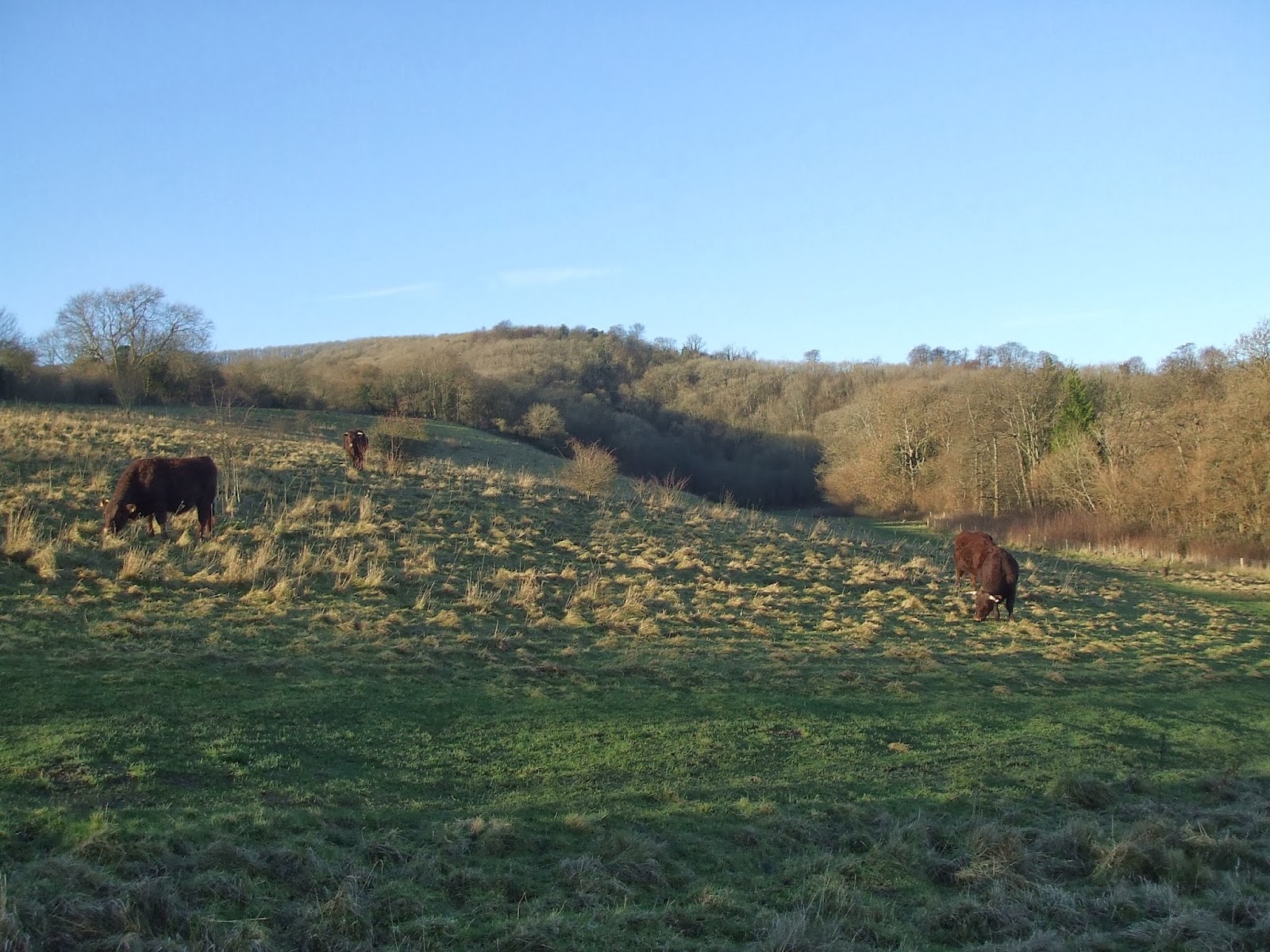
The small grazing herd of Sussex Red cattle have been back for quite a while now and are munching their way through a lot of the long grass on the hillsides.

Beeding Brooks

29 July 2017 Very quiet as it is now the end of the breeding season.  A brief burst of Reed Warbler song, glimpses of Reed Buntings, but ...